One of the highlights of my baseball year every year is the annual SABR national convention, which is held in a different city every summer. Not only are there dozens of presentations of research on every conceivable topic from Tommy John surgery to stadium design to the life of Japanese beer sellers, SABR usually pulls in some All-Star presenters like this year’s panel of 1990s Cleveland Indians that included Kenny Lofton, Sandy Alomar, Mike Hargrove, Carlos Baerga, and Charlie Nagy.
The highlights typically include a trip to a ballgame, a late-night baseball card “pack rip” hosted by the Baseball Cards Committee, and tours of local baseball historical sites. It’s a fantastic time, I never get enough sleep, and I arrive home exhausted but with my brain stuffed full of new knowledge.
I used to often post a lineup of nine new things I learned, but then I got real busy working for SABR, editing the BRJ and directing publications, and I didn’t write much. Now that I am handing off many of my SABR responsibilities, it’s time to get back to that tradition.*
1. Did you know that the Colorado Silver Bullets all-women’s baseball team, which was created as a promo vehicle for Coors Light back in 1991, was probably not created for the reason most people think?
The barnstorming team was managed by Hall of Famer Phil Niekro and operated 1994-1997. Roberta Newman, a scholar of both baseball and advertising (and author of Here’s the Pitch) presented her findings and speculations about the Silver Bullets’ origin story.

The usual story is that Coors was trying to market light beer to women, but Roberta finds it more likely that the Silver Bullets were meant to be a reputation-washing stunt after a long, bitter AFL-CIO strike against Coors and related boycott. Coors, at the time, wasn’t well distributed nationally and was best known on the West Coast. The strike and boycott, which eventually encompassed LGBTQ rights groups, women’s rights groups such as NOW, and various ethnic groups, all of which had been discriminated against by Coors in their hiring practices and business dealings, drove their distribution in California down so badly the company was essentially forced to nationalize. (To this day, many gay bars will still not serve Coors.) There’s little to suggest in Coors’ memos or documentation that they were thinking of women as consumers at all, but plenty to suggest they wanted something to repair the damaged “right wing” reputation of the company. Executive Bob Hope (no relation) had seen the recent box office success of the movie A League of Their Own and, as the saying goes, the rest is history.
2. John McGraw’s turn at Hollywood stardom has been lost forever.
 Back in 1925, when John McGraw of the New York Giants was at the peak of his fame and influence, he starred in a silent film serial entitled Play Ball, produced by Pathé, the same company behind The Perils of Pauline (1914) and The Man Without a Face. These pulpy serials were often melodramas, and Play Ball included various non-baseball plot twists such as a shark attack and a calamity at a carnival. Longtime SABR researcher, writer, and editor Dan Levitt (author of several books including one onEd Barrow) presented about the production, including many stills from the films, clips from newspapers, and so on.
What Dan couldn’t present was any footage, because Play Ball is considered lost. Many old films have not survived to today because the film stock they were made on was highly flammable and can self-ignite if not stored at near-freezing temperatures. (Unfortunately for McGraw perhaps, what really torched Play Ball was the scathing negative reviews of the serial.)
3. Linguistics belongs at SABR.
Well, really, any academic discipline can be applied to baseball, so linguistics is far from the only one that belongs at SABR but that we rarely see. But Lindsay Dial got her MA in computational linguistics and she studied bias in baseball writing and reporting by showing that certain descriptive words get applied to some players more than others.
This can be studied both on a group level and on an individual level—for example, words most often associated with Juan Soto in 2018 included superstar, toolsy, MVP, but after going to the Mets in 2022 while superstar is still there, the words underperforming and overpaid suddenly jump into the list. On a group level, systemic biases become visible and statistically provable when differences appear in the language used to describe, say, Latino players versus non-Latino players who otherwise have the same stats. Also predicting the accuracy of terms like “ace” and “slugger” which do seem to correlate to the relevant stats, while the word “clutch” did not—although whether that is because being a “clutch” player is an illusion or because any player can have a “clutch” moment or a clutch play, and so where the word appears may be very inconsistent.
I didn’t take adequate notes during this presentation because I was so caught up in it: it was my favorite of the weekend and the one I think I gave the highest judging scores to.
4. The metaphors write themselves.
Another of my favorite presentations was Victoria Lovinggood’s “Ethics on the Diamond: Understanding MLB’s Steroid Era Through Organizational Culture and Moral Reasoning.” I haven’t studied ethics so this was a fascinating look at ethics as a formal academic discipline. She laid out a four-part framework that shows ethical behavior is shaped by four systems. Formal systems (stated rules and policies), informal systems (cultural norms and peer behavior), incentives (what the system rewards), and leadership signals (what leaders tolerate or ignore).
When these four systems are not aligned, misconduct is predictable. For example, if you have laws, but the leadership are often seen flouting those laws, others are likely to also flout them, because they may feel they have tacit permission to break the rules or that they won’t be punished. Within this framework, Major League Baseball’s total failure to deal with their PED problem at every stage—worsening it at every step—is obvious and predictable. Ultimately, cultural norms will always override lip service from leadership, and without strong, independent enforcement, the incentives mean that you will inevitably grow a culture of tacit approval for rule-breaking. Lovinggood didn’t mention anything about American politics, but she didn’t have to.
5. MLB players are afraid to know the truth about UCL tears.
Dr. Levon Nazarian, MD, presented 18 years of research into pitching elbows, showing that using ultrasound instead of MRI can better reveal damage and function loss. Ultrasound machines are cheap compared to MRI and an athletic trainer can do imaging easily while moving the elbow around and placing it under stress. The movement reveals many dysfunctions that aren’t seen when in a motionless MRI, including ulnar nerve dislocation and what degree of unnatural slack the UCL may have developed. (Even better, combine US and MRI results for a complete diagnostic picture.)
He imaged many pitchers in the Phillies organization because the Phillies were interested in trying to learn whether various treatments or exercises might proactively prevent Tommy John surgery or if they could discern when in the wearing down of the UCL one should start being proactive. But the sample sizes were too small to reach statistical significance. The way to get that data, which would likely benefit the health of all pitchers, would be to do these studies on every pitcher in MLB and MiLB, but the Players Association would not agree to it. They’re too afraid that too many guys would simply miss out on big contracts based on what damage would be revealed. Instead they just want to gamble on their arms, and keep competing until their UCL blows out.
6. The Japanese take being “bleacher creatures” to a new level.
Rob Fitts gave a presentation based on his recent book In The Japanese Ballpark, which features interviews with people working in many different roles in and around Japanese pro baseball, from five-foot-tall beer girls who get their 44 pound kegs refilled and refitted like Formula 1 race cars and who wear knee pads so they can kneel as they pour a beer to make sure they aren’t in the way of anyone’s view of the field, to professional cheerleaders, to the fans who make up the cheering section, or oendan. Every team has an outfield section akin to Yankee Stadium’s bleachers where the most diehard fans cheer on their team. Imagine if the Yankee Stadium roll call went on not just in the first inning but throughout the entire game, crossed with a Big 10 pep band, and you have an idea of what the oendan are up to. They have a unique cheer for each batter and they sing/play many fight songs. Although the oendan are independent of the pro teams, they are highly organized, holding auditions and requiring their members adhere to rules of conduct such as no drinking alcohol in the stadium. A typical oendan member might rotate in a game from leading the section in one inning to waving a flag in another to playing an instrument. (Some activities are so tiring no one does them for more than one inning.) I’ve been to see baseball in Japan a couple of times and the most amazing part to me is that there is also a reserved section of bleachers for the visiting team’s oendan!
7. Was the movie Major League responsible for Cleveland’s name change…?
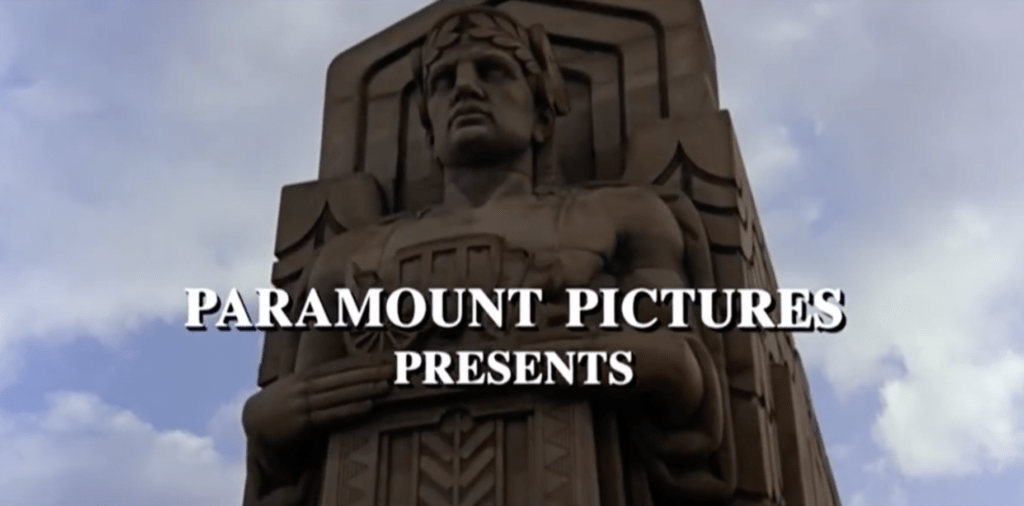
It’s no secret that the movie Major League, a sports comedy from the 1980s, is beloved among baseball fans, especially in Cleveland, where the movie is set. One of the SABR convention’s evening sessions was a Q&A (via Zoom) with filmmaker David S. Ward, who told many fun and raucous stories from behind the scenes. There are rumors that many in the Cleveland front office watch the movie on a regular basis, perhaps as a rite of passage for new hires, and Bob DiBiasio was the guy who had final approval on the script. (DiBiasio is still the Indians senior V.P. of public relations, and he also made an appearance at SABR 54.) After the Q and A ended, SABR screened the film. You know what the opening shot is? The very first image you see in the film? That’s right. It’s the iconic Guardian.
Now we have to get Bob DiBiasio and David Ward back on Zoom for a follow-up question. Until then, this is purely my speculation. But it’s my headcanon now that Major League planted the idea, whether explicitly or subconsciously, for the team to become the Guardians.
8. There can be contradictory outcomes in safety initiatives.
I’ve heard from time to time that data makes it seem as if bicyclists who wear helmets may be less safe than those who don’t. This next presenter is the guy I should have asked about that.
Matthew E. Martin, from University of Southern Mississippi, presented his research about fan perceptions of risk and safety regarding the protective netting at major league ballparks. First off, it’s hard to calculate just how much danger there actually is from flying bats and balls because MLB does not share data about how many incidents there are. There are definitely more foul balls than there used to be (there are numerous studies of the increase) but what has really increased the most is awareness, because whenever someone gets injured by a bat or ball flying into the stands, nowadays there will be numerous viral videos going around about it. Although these incidents are probably still rare, the injuries can be very serious and have even caused death.
But humans are bad at assessing danger: Martin pointed out people are much more afraid of sharks than bathtubs, but you are far more likely to die in the bathtub than get bitten by a shark. As people’s awareness of some of the more gruesome examples grew, MLB had to extend the netting. But although extending the netting has undoubtedly increased safety at ballparks, it may have ironically also increased fans’ feelings of safety so much that it actually reduces their self-efficacy–their efforts and ability to protect themselves. You can still get hit by the ball through the screen, but if you falsely feel protected, you might not be as alert for danger as you should be. Martin suggests MLB needs some updated reminders for people to maintain situational awareness, and that these don’t have to be negative: What about some signs and billboards saying, “Souvenirs are everywhere!”
9. And the final thing I learned at this year’s SABR convention, I have to figure out how to get more sleep.
I ended up missing a bunch of presentations on the final day because I was so tired after several nights in a row of only 4-5 hours of sleep that I could not climb out of bed. I track my health stats using a smart ring, and the tracking software didn’t even believe I slept at all one of those nights. (I thought I slept four hours.)
What can I say? Baseball research makes me like a kid on Christmas and sleep is just impossible. But as I’m getting older, lack of sleep is wearing me down more and more. Next year I’ll have to try to bring melatonin or warm milk or something.
Speaking of which, next year’s convention will be in Birmingham, Alabama. It’ll be the first time SABR isn’t in a major league city since 1997, but this is all about the possibility that there won’t be MLB action in 2027. Birmingham is the home of Rickwood Field, one of the most historic ballparks in the country, and this is probably the one time I’ll get a chance to see it! So you bet I’ll be there.
—
* I am still Publications Director for the time being, which means I still oversee production and distribution of SABR’s books, but I’m no longer editing the Baseball Research Journal. I took a sabbatical last year to write the SABR Baseball Style Guide for University of Nebraska Press and while I was out Liz Roscher was the interim editor, but we’ve taken the “interim” tag off now and she’s handling the BRJ and TNP from now on! Meanwhile, I’m planning to retire from directing the book program as soon as the organization figures out how to replace me. A committee has been convened on the subject! Stay tuned, and meanwhile look for the Style Guide book to come out in 2027.


Leave a Reply